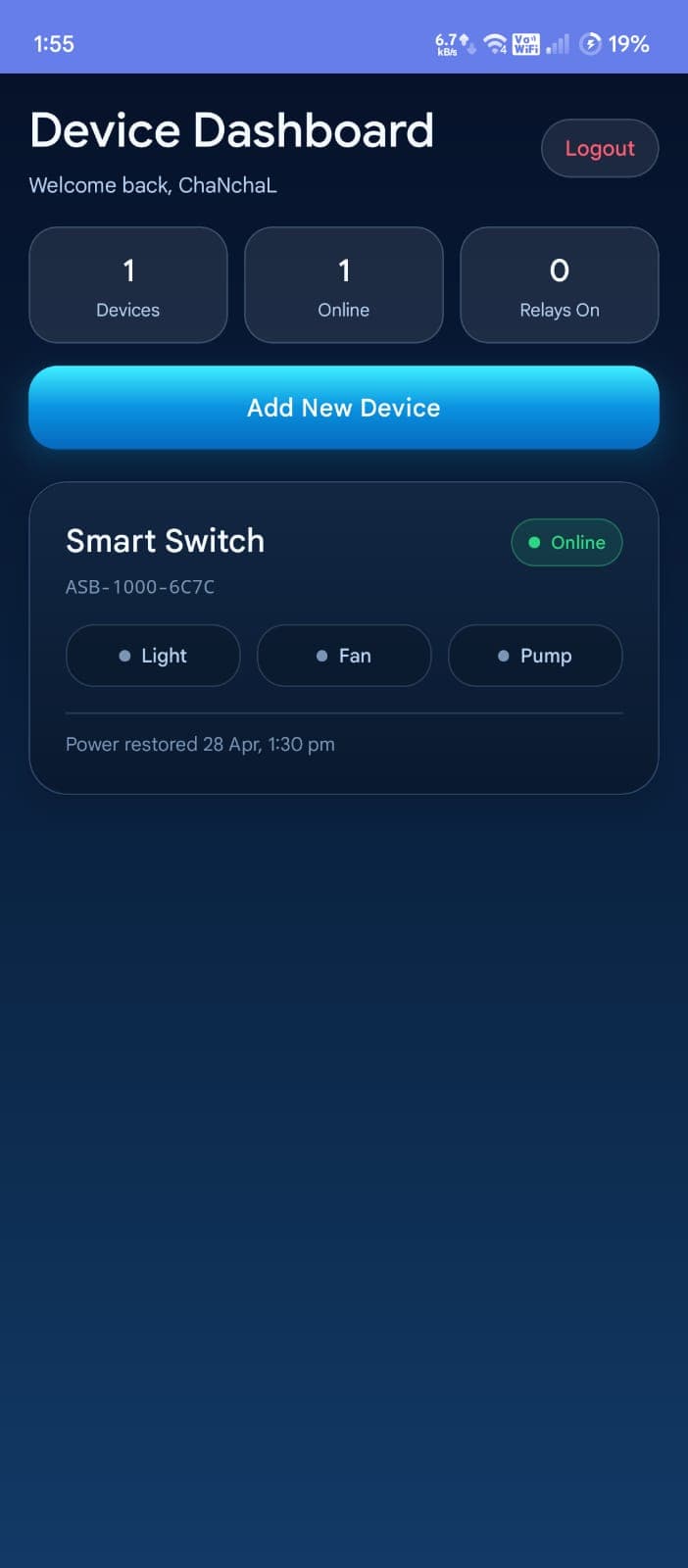
Device dashboard
The dashboard gives the user a quick operational view of device count, online status, relay summary, and the connected Smart Box overview.
Connected IoT case study
IoT smart switch platform with ESP32 firmware, cloud backend, mobile app, and web dashboard
AasPas Smart Box is a full-stack IoT control platform built around real household automation. It combines ESP32 firmware, a Node.js backend, MongoDB persistence, Socket.IO realtime state, a Next.js web dashboard, and an Expo-based mobile app. The system supports device claiming, relay control, per-relay timers, daily and one-time schedules, energy tracking, device presence monitoring, power-loss recovery, and fallback behavior when realtime transport drops.
Live relay control, schedule automation, energy insights, and device health are all surfaced through the mobile product instead of being hidden behind firmware-only tooling.
System topology
Mobile walkthrough
These screens show that Smart Box is not a concept-only IoT demo. It already has real onboarding, connected-device overview, relay control, schedule setup, and energy analytics surfaces.
The dashboard gives the user a quick operational view of device count, online status, relay summary, and the connected Smart Box overview.
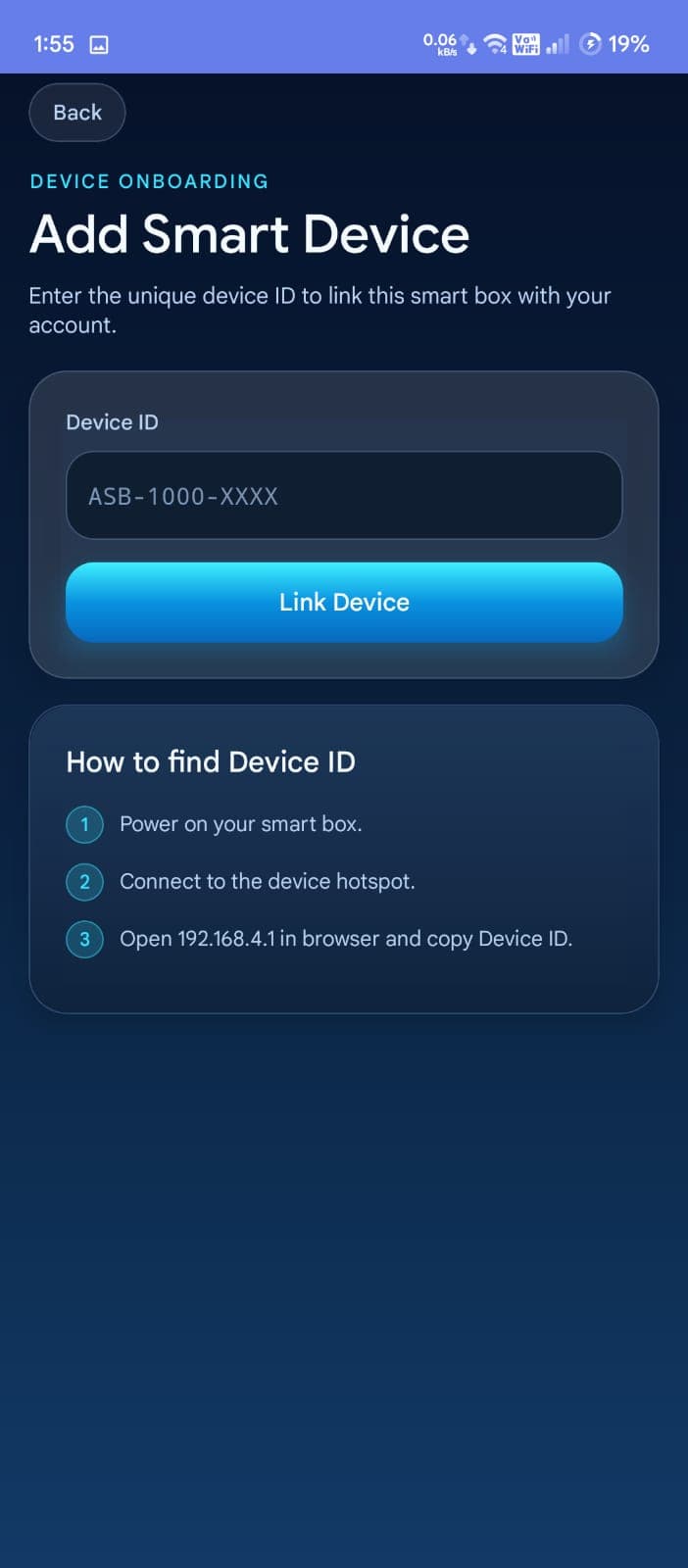
Device claiming is designed as a real onboarding flow where users link a Smart Box by device ID and follow setup instructions instead of dealing with raw hardware steps alone.
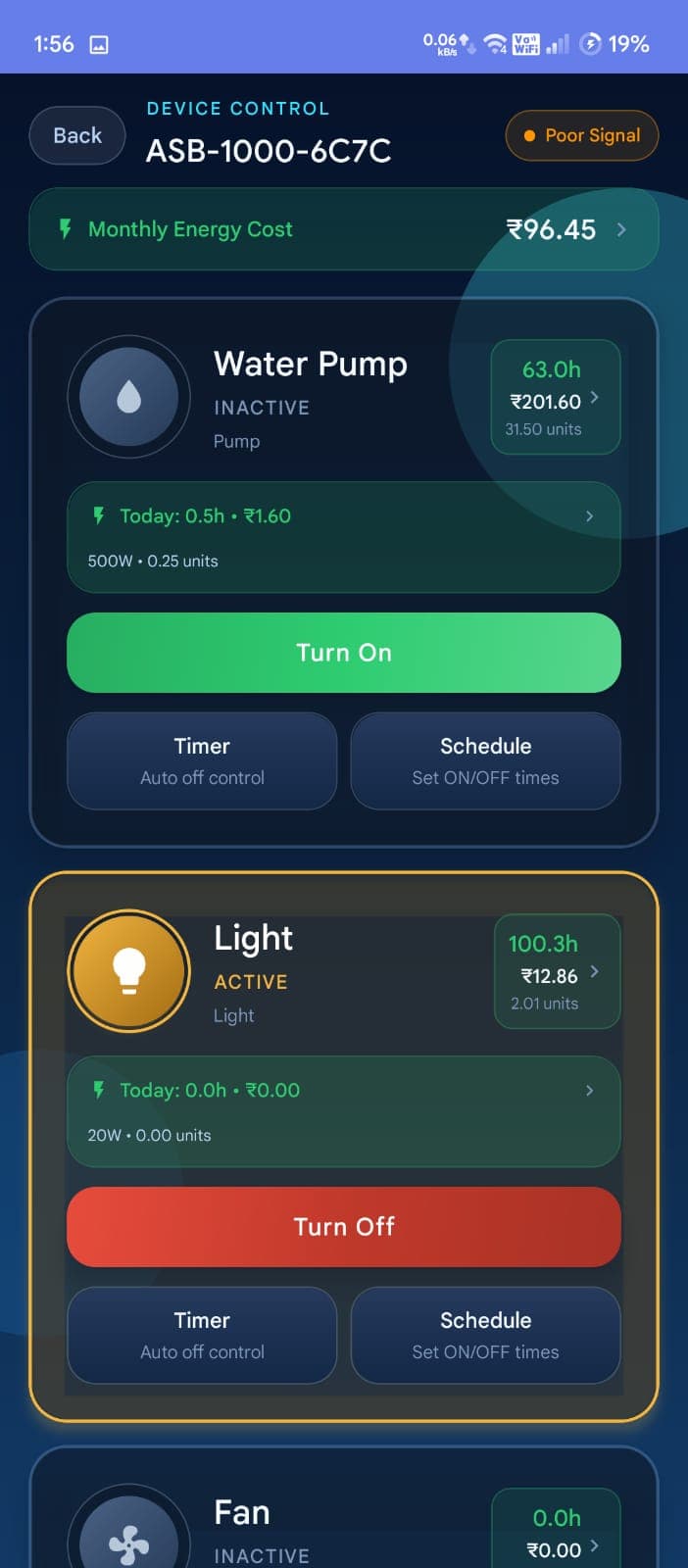
The control screen shows independent relay state, on and off actions, live status, relay-level runtime and cost indicators, and direct access to timers and schedules.
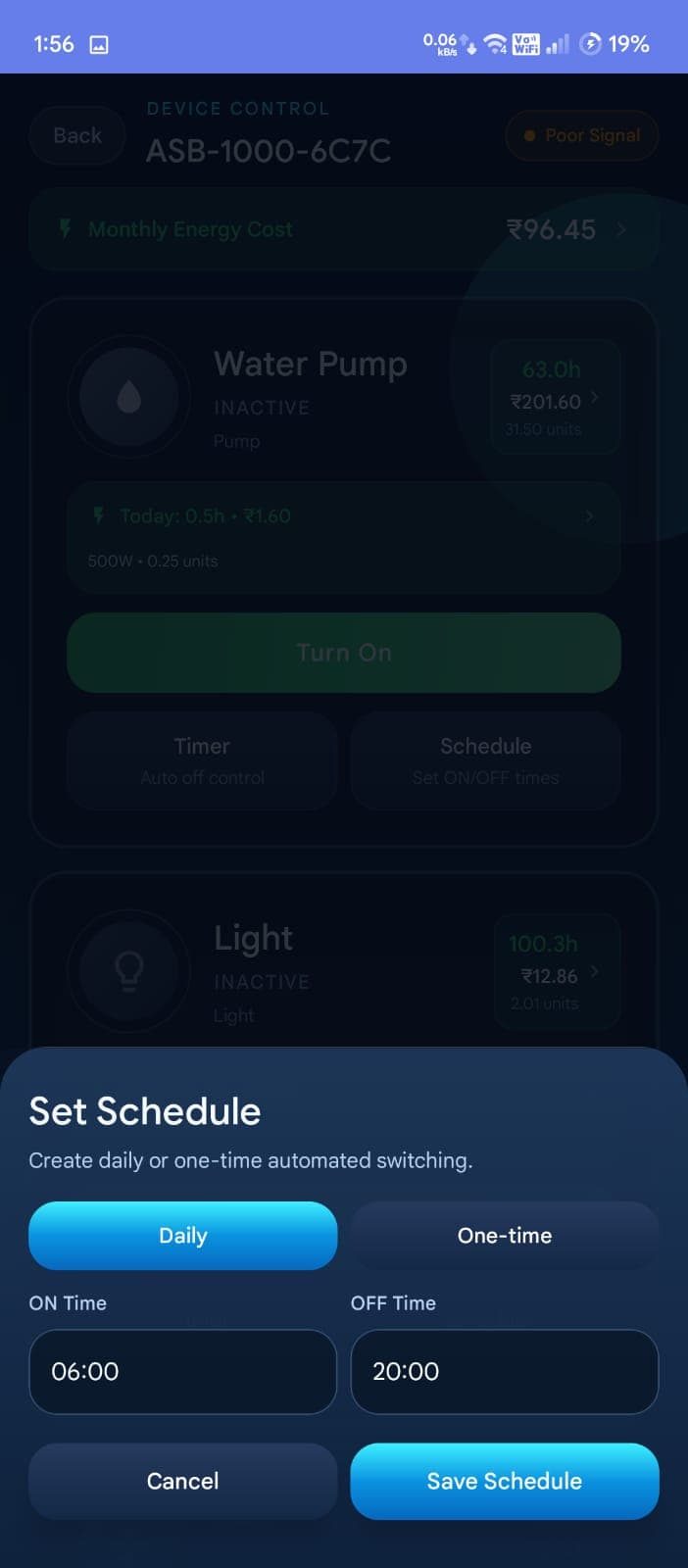
Daily and one-time automation are exposed through a clean mobile scheduling UI so household automation feels practical rather than hidden behind backend-only logic.
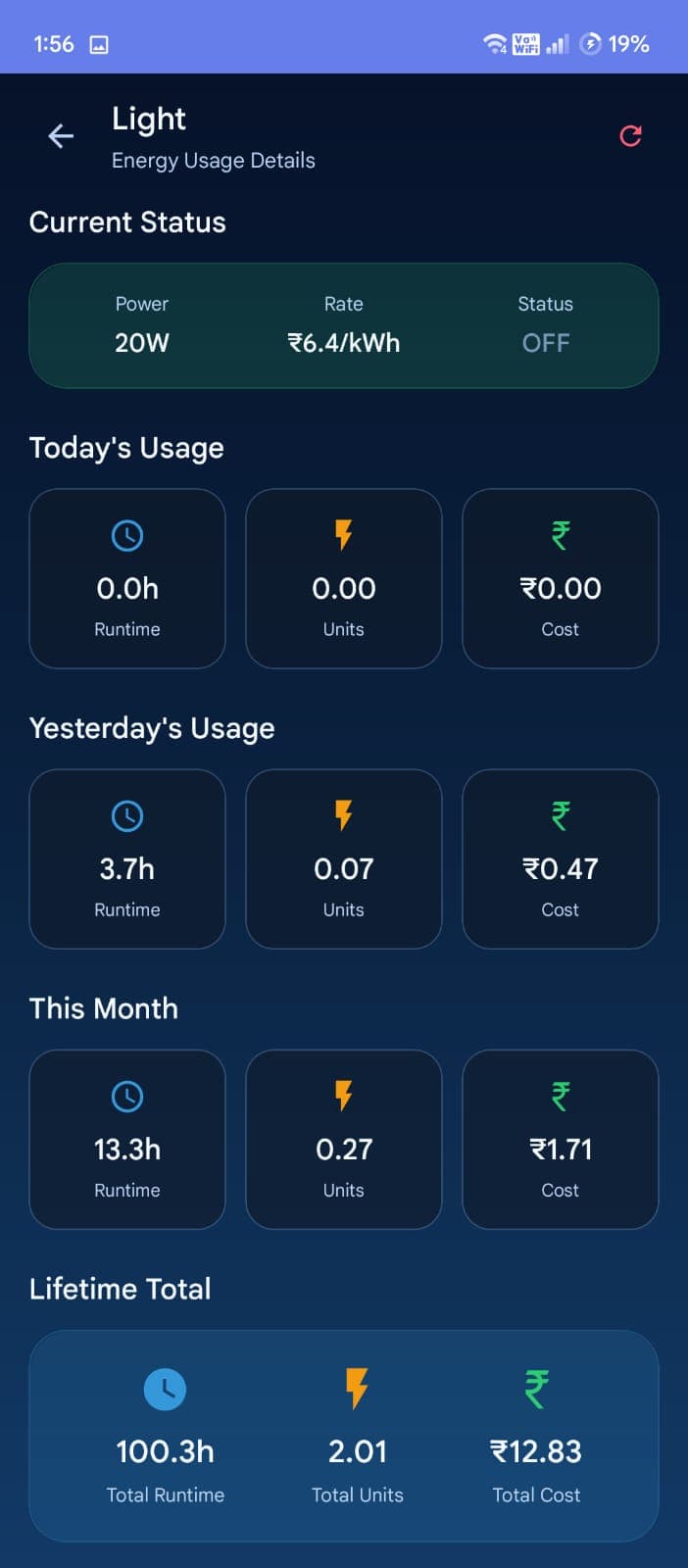
Relay-level runtime, units, and rupee cost are surfaced across today, yesterday, month, and lifetime views to make the product useful for monitoring as well as control.
System map
Smart Box is not only a remote switch. It is a hardware-to-cloud product where device identity, ownership, relay automation, analytics, and recovery all matter at once.
Users sign up, claim devices by ID, manage multiple Smart Boxes, and control only the hardware they own through authenticated APIs and device-aware realtime subscriptions.
Three separate relays can be controlled independently with immediate toggle, timer automation, daily schedules, and one-time schedules for household devices like lights, fans, and pumps.
Device and user clients maintain Socket.IO connections with heartbeat acknowledgements, room-based updates, and online/offline state transitions backed by server-side presence handling.
Per-relay energy configuration tracks watts, runtime, unit consumption, cost, daily history, monthly usage, and all-time overview with user-facing analytics.
When household power fails, timers pause, energy tracking stops, outage history is recorded, and the system resumes intelligently when the device reconnects.
The platform includes firmware-compatible APIs, a Next.js dashboard, an Expo mobile app, and backend automation logic, making it a real multi-surface IoT product.
Platform surfaces
This project spans hardware, cloud, mobile, and web. That cross-surface complexity is exactly what makes it strong portfolio material.
The hardware surface is designed around real device identity, network uncertainty, and relay-by-relay control rather than a basic serial demo.
The mobile product gives users a polished handheld control surface for automation, device status, and energy visibility.
The Next.js dashboard provides another surface for login, device claiming, status monitoring, and relay automation from desktop browsers.
The backend is where the system becomes production-like: ownership validation, device routing, timers, schedules, heartbeats, and energy correctness all live here.
Technical architecture
The stack spans embedded hardware behavior, authenticated backend APIs, realtime transport, web control surfaces, mobile UX, and analytical energy logic.
The embedded side is shaped around device identity, WiFi setup, cloud communication, and relay-oriented control, not just local switching.
Backend services handle auth, device ownership, relay commands, timer and schedule automation, presence management, and persistence.
Socket.IO synchronizes device and user clients while heartbeat acknowledgements help the platform understand connectivity and offline transitions.
The browser dashboard provides desktop-friendly device management and automation setup with a clean operational surface.
The mobile app brings the same control and monitoring flow into a handheld format with richer device cards and energy-specific views.
Device analytics and resilience behavior make the product significantly deeper than a basic on-off switch.
Automation systems
Automation depth is one of the strongest parts of this product because timer and schedule logic work independently per relay instead of being a single global switch.
Per-relay timer automation instead of device-wide only timers
Daily schedules and one-time schedules for each relay independently
Automatic ON/OFF execution driven by backend automation logic
Timer pause and resume behavior when relay state changes or power fails
Schedule persistence in MongoDB so automation survives reconnects and app restarts
Realtime status emission so apps see automation changes immediately
Energy intelligence
The energy layer gives the product more depth than a simple home switch because users can estimate runtime, units, and cost per relay over time.
Wattage and unit-rate configuration per relay
Today, yesterday, monthly, and all-time runtime calculations
Unit and rupee cost estimation for each configured relay
Monthly overview screen aggregating multiple relays into one device-level summary
Relay-level energy details with breakdown and reset support
Energy tracking pause and resume logic tied to actual device availability
Reliability
Real homes have power cuts and unstable connectivity. The resilience logic in this system is what makes it feel more production-grade than a hobby-only IoT build.
Device heartbeat monitoring with offline timeout handling
Socket disconnect and reconnect awareness for both users and ESP32 hardware
HTTP polling fallback when direct realtime transport is unavailable
Power-loss detection that pauses timers and energy computation instead of producing false data
Power restoration logic that resumes timer and energy state correctly
Outage history storage for reliability insight and retrospective visibility
Security and ownership
Since this is a cloud-controlled device system, ownership validation and control security are central to the product, not optional extras.
Ownership
This is another project where the value comes from system breadth: device logic, backend automation, web, mobile, and reliability decisions all had to come together.
Technology index