Commerce beyond a landing page
The project connects product discovery, cart, checkout, orders, tracking, cancellation, and reviews into a believable customer commerce loop instead of stopping at a hero section.
Commerce case study
Premium food commerce system with customer auth, order lifecycle, reviews, subscribers, and admin operations
Mushdelight is a premium food-commerce website designed as a complete customer and business system rather than only a storefront landing page. The project includes customer signup and login, OTP verification, forgot and reset password flows, product catalog browsing, cart and checkout screens, order placement, tracking, cancellation handling, product reviews, contact flows, subscriber capture, and admin-side product operations. Under the hood it uses Next.js, React 19, MongoDB, Mongoose data models, JWT-based auth patterns, Brevo-powered communication flows, and operational APIs for products, settings, reviews, contacts, and customer orders.
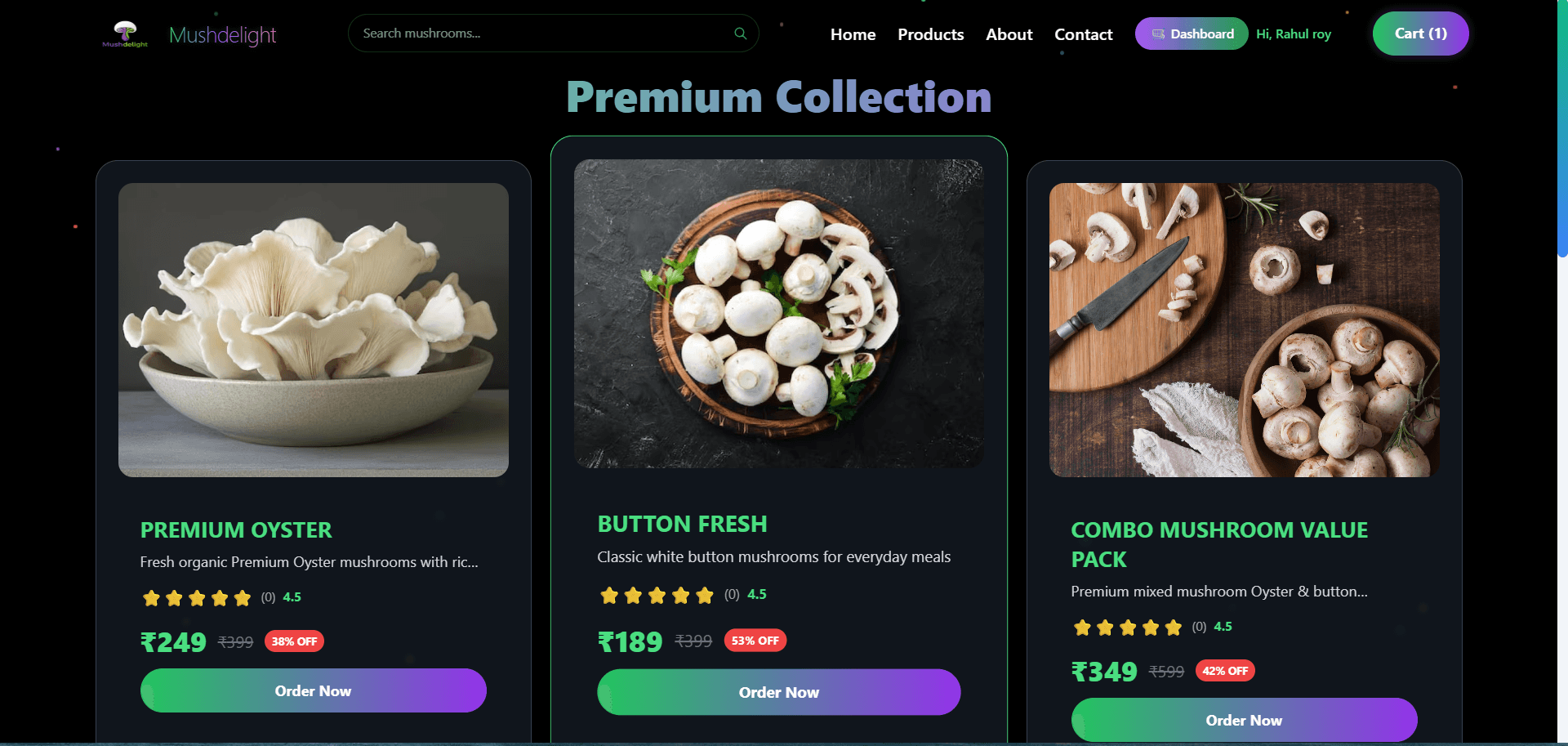
System proof
The project connects product discovery, cart, checkout, orders, tracking, cancellation, and reviews into a believable customer commerce loop instead of stopping at a hero section.
Login, signup, OTP verification, forgotten-password recovery, and profile-linked order visibility give the product a fuller account system than many demo storefronts.
Contact submission, subscriber collection, and email-oriented workflows make the website useful for ongoing brand communication as well as order capture.
Models and APIs for products, orders, reviews, settings, contacts, and subscribers show backend structure that supports day-to-day business operations.
The website supports product discovery, product detail exploration, cart building, checkout progression, and order completion as a connected purchase journey.
Signup, login, OTP verification, forgot password, and reset password screens turn the project into a fuller customer-account product instead of a guest-only demo.
Customers can view their orders, inspect status, track progress, and cancel where the flow allows, which makes post-purchase behavior part of the system.
Product reviews and rating-oriented data models add social proof and customer feedback loops to the commerce experience.
Subscriber capture, contact messaging, and email delivery infrastructure make the product more realistic for a brand that wants retention and communication, not only one-time orders.
Admin APIs for product management, reorder behavior, settings, and protected access prove there is an operations layer behind the public storefront.
The customer-facing site is built with modern Next.js and React, with route-level flows for auth, cart, checkout, orders, reviews, and profile-connected shopping behavior.
MongoDB-backed APIs support products, orders, carts, reviews, subscribers, contacts, settings, and authenticated customer interactions.
The product uses JWT-style auth patterns plus OTP and reset-password support so customer access behaves more like a production commerce app.
Brand and customer communication is handled through subscriber flows, contact handling, and email infrastructure rather than being left out entirely.
Ownership
Technology index